Kalimbinator
A hand-crank music box that plays the opening of the tenor saxophone solo from Omar Thomas' Come Sunday, built around a re-tuned kalimba and a drum I designed and 3D printed to pluck out the notes in sequence.
- Role
- Design, build & tune
- Tools
- CAD, 3D printing
- Power
- Hand-crank
The idea
I wanted to build a device that could play a piece of music on its own. Rather than reaching for motors and microcontrollers to automate it, I looked to traditional music boxes for inspiration: mechanical instruments that turn the simple act of cranking a handle into a melody. That became the starting point for the Kalimbinator, a music box re-engineered around a kalimba to play the first phrase of the tenor solo from Come Sunday.
The approach
I sourced a kalimba sized to fit my printer's build plate, disassembled it, and reworked its tines to the exact notes the solo needed. From there, the project became a CAD problem: design a drum and housing that could pluck those tines in the right order as it's turned by hand, then print, tune, and assemble the whole thing into a working instrument.
Six iterations to get the geometry right
The final assembly is a hand crank turning a drum studded with pegs, housed in a shell sized to wrap around the kalimba and hold it at an angle. Getting there took six rounds of CAD prototyping, working through how each peg needed to be placed and angled to strike its tine cleanly without the drum's pegs needing to extend so far that they'd flex or catch.
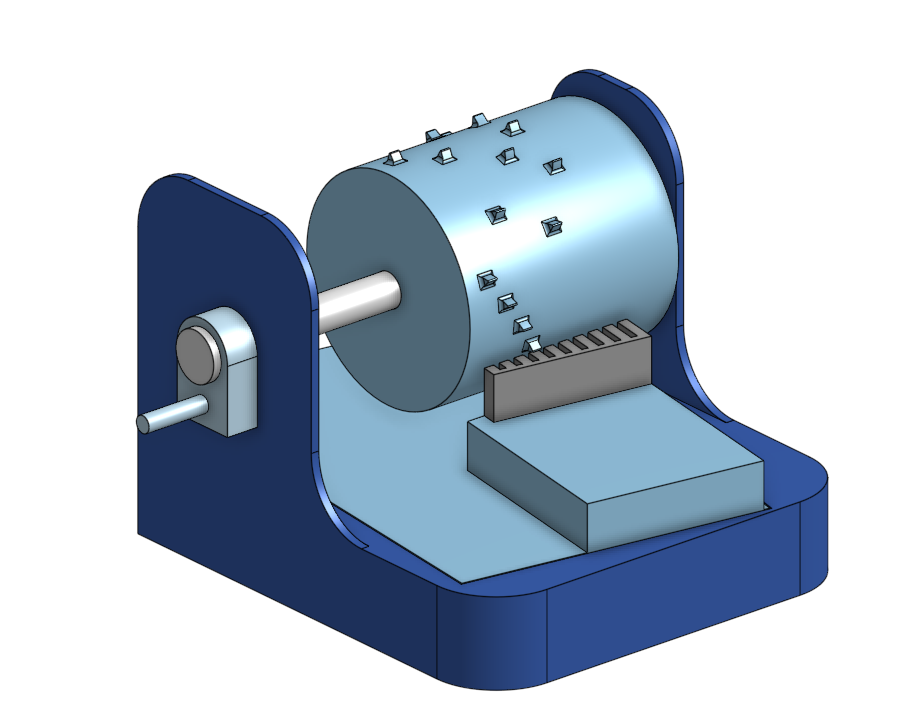
The final model: a hand crank drives a peg-studded drum that plucks the kalimba's tines in sequence as it rotates, housed in a shell sized to wrap around the instrument and hold it at an angle.
Turning the crank rotates the drum, drawing each peg across a tine in order and plucking out the opening notes of the solo, just like the music boxes that inspired it.
How it came together
- 01
Re-tuning the kalimba
I disassembled a kalimba sized to fit my printer's build plate, transposed the solo from tenor saxophone into concert pitch, and rebuilt it with only the tines the piece required. Each one was tuned to match, then arranged from lowest to highest so the drum could be angled without the pegs needing to extend too far.
- 02
Modeling the mechanism
Working from the sheet music, I mapped each note onto the drum in CAD and worked through six prototypes before landing on a model that matched the real kalimba's geometry and held every peg at the angle it needed to play cleanly.
- 03
Printing & assembly
The full housing and drum came out of a single six-hour print, and the assembly was mostly a matter of gluing the pieces into place. After test-running it, I noticed a gap between the drum and the kalimba and printed a separate spacer to close it so the pegs could reach the tines properly.
The Kalimbinator doesn't play perfectly, but it plays, and that was the point: a chance to take two things I care about, engineering and music, and find a real connection between them. Between the CAD work, the tuning, and the print-and-fit cycles, it pulled together a lot of what I'd picked up through robotics and design into one instrument I can turn the crank on and hear come to life.