Gesture-Controlled Drone
A drone you fly with your hand instead of sticks: curl your fingers and a sensor glove sends the same commands a transmitter would, to a 3D-printed aircraft whose ducts keep the props out of trouble while it learns to hover.
- Role
- Design & build
- Tools
- CAD, ESP32, Betaflight
- Control
- Flex-sensor glove
- Demonstrated
- Lift-off & live channel input
The idea
Conventional drone controllers typically use two sticks, and learning them is half the battle. We wanted to skip the sticks entirely: point your hand, curl your fingers, and have the aircraft respond. That turned one project into two builds that had to meet in the middle, a custom aircraft and a wearable controller, split between me and a friend.
The system
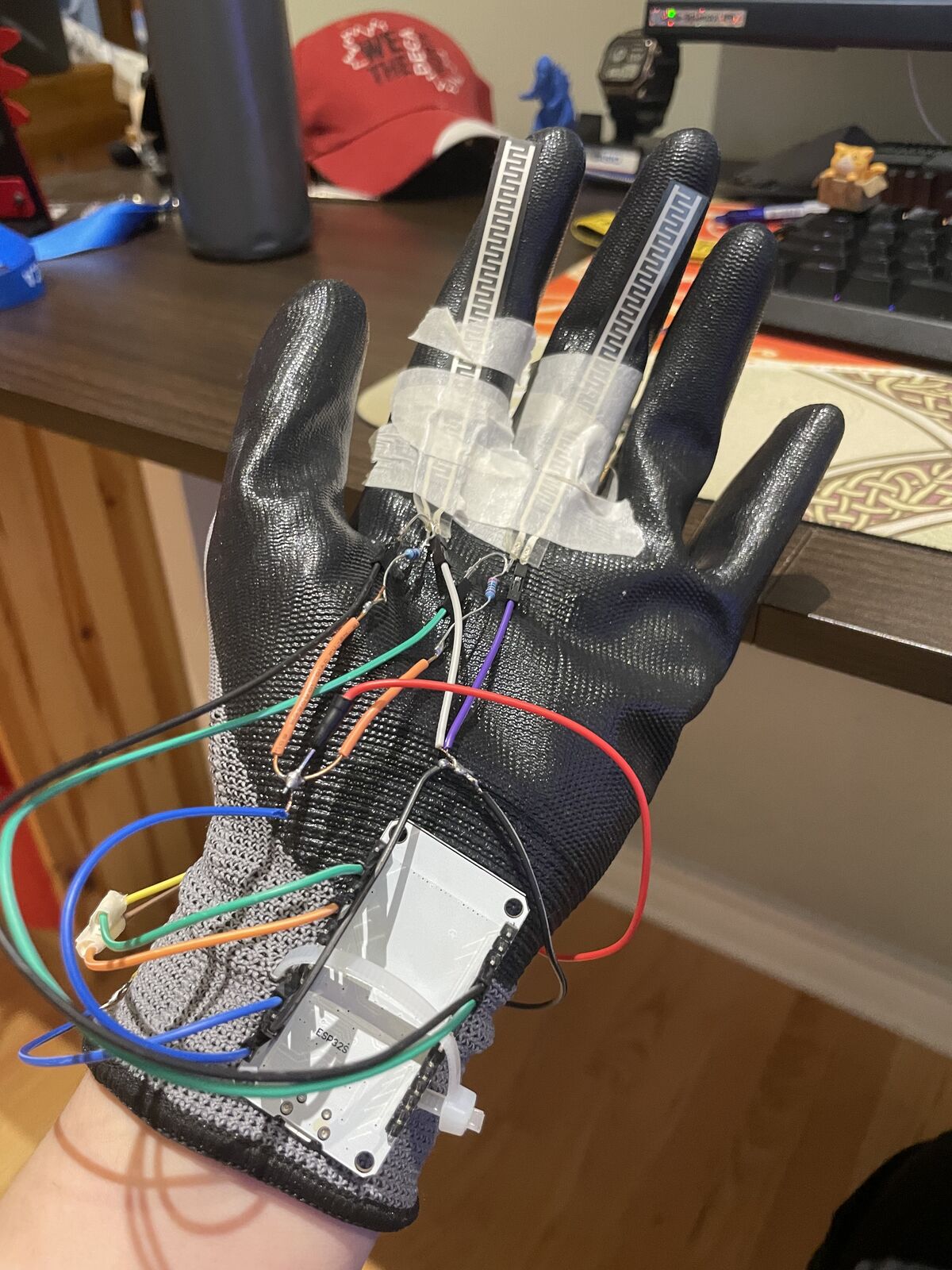
Three flex sensors and a motion sensor on a glove read your hand pose. An ESP32 on the back of the hand converts finger curl and orientation into the same channel commands a normal transmitter would send, and streams them wirelessly to a receiver board riding the drone, where a Betaflight flight controller turns them into motor output.
An airframe printed in one piece
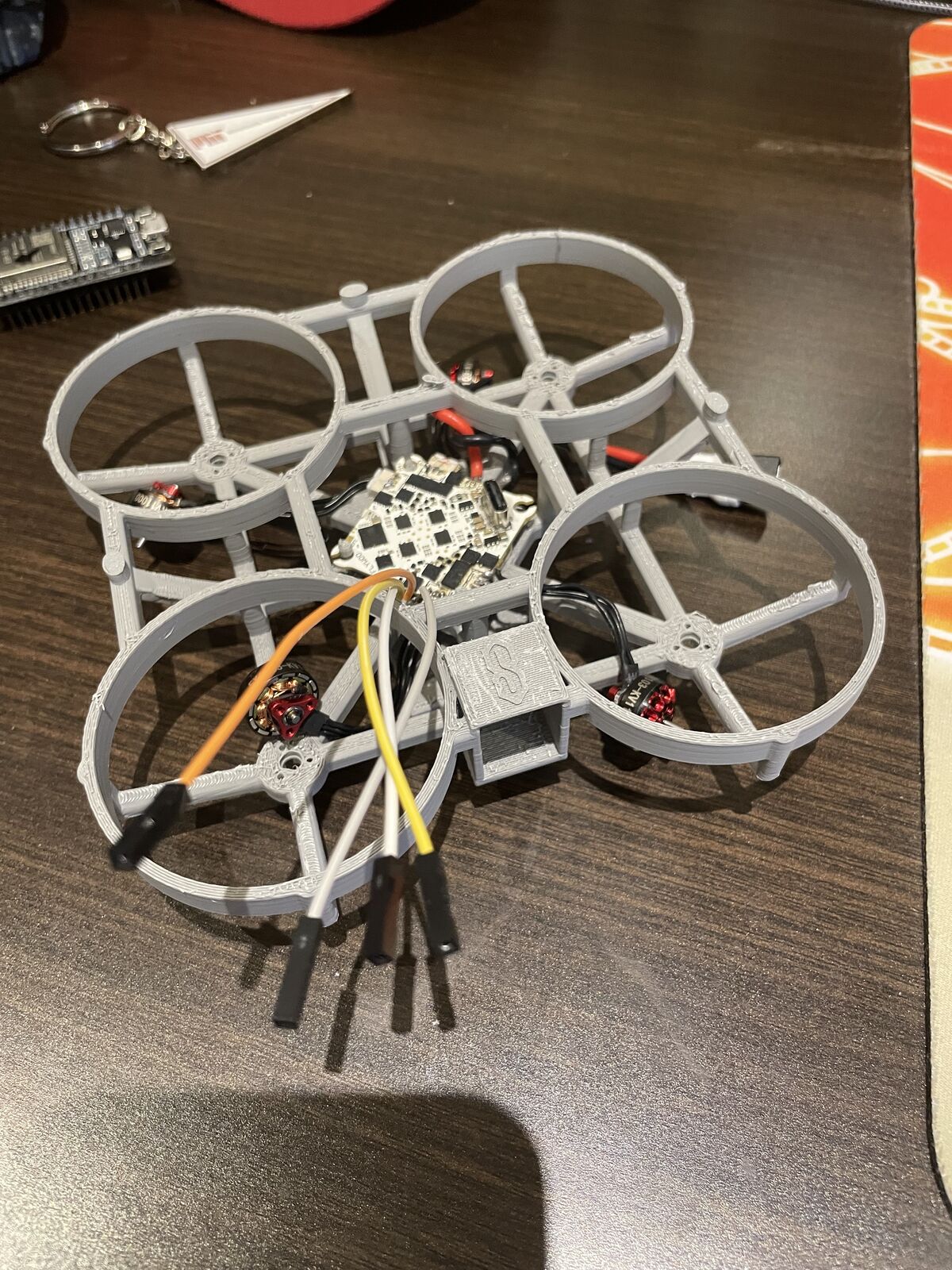
The frame was modeled in CAD around the electronics it had to carry: four brushless motors inside full prop ducts, a whoop-class flight controller in the center, and a mount for the radio board. The ducts double as crash protection, which mattered, because a drone learning to read hand gestures spends a lot of time landing badly.
Motors mounted and wired, with the four prop ducts printed directly into the frame instead of bolted on afterward.
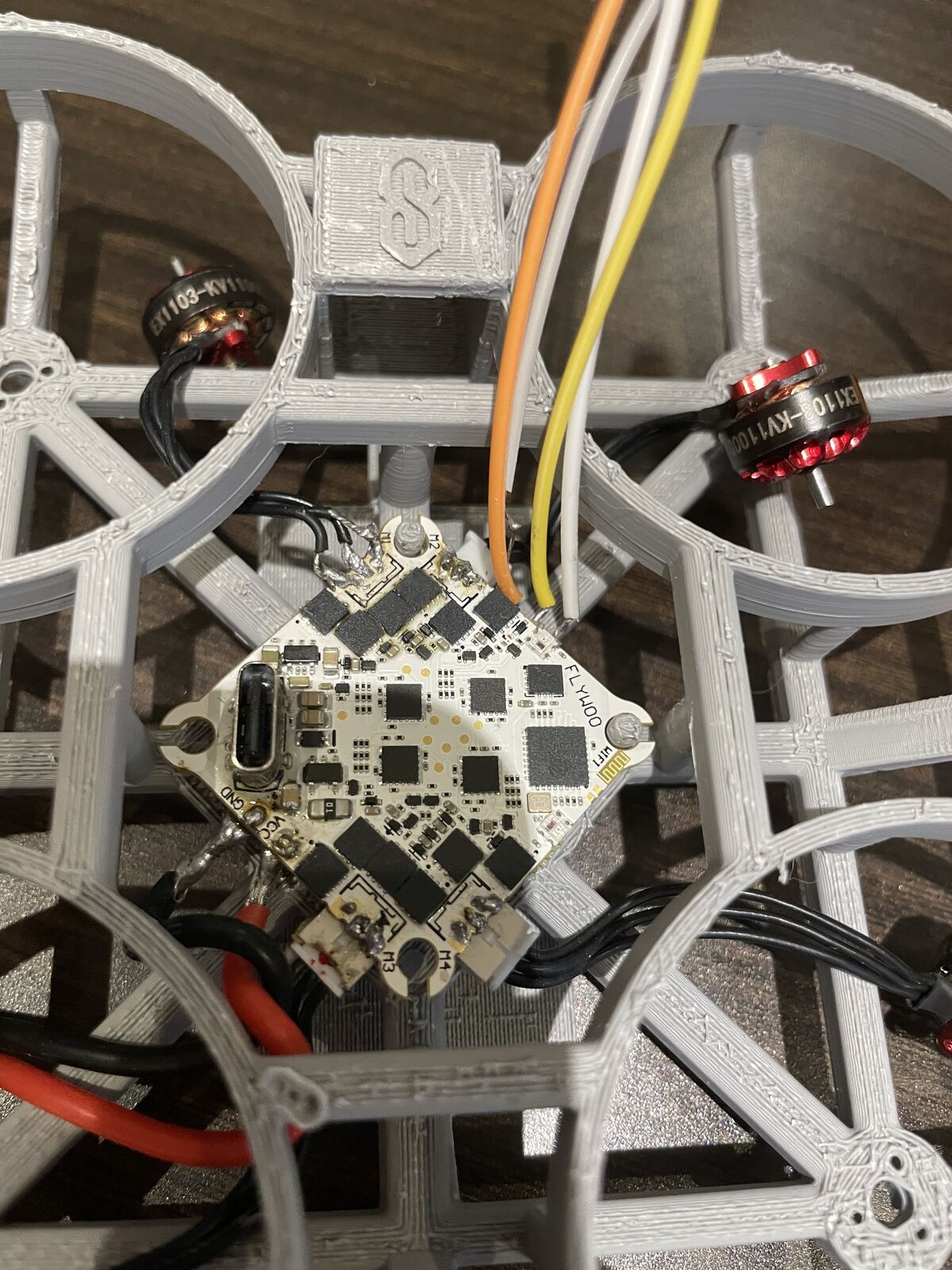
A whoop-class all-in-one flight controller sits dead center, running Betaflight and driving all four motors.
A transmitter you wear
The controller is a work glove with three flex sensors taped along the fingers, each one a simple voltage divider whose resistance changes as the finger bends. The ESP32 reads them alongside its motion sensor, maps the raw readings through a calibration curve, and sends the result to the drone many times a second.
Flex sensors run down the fingers and the electronics ride the back of the hand, so the controller is light enough to wear and goes wherever your hand does.
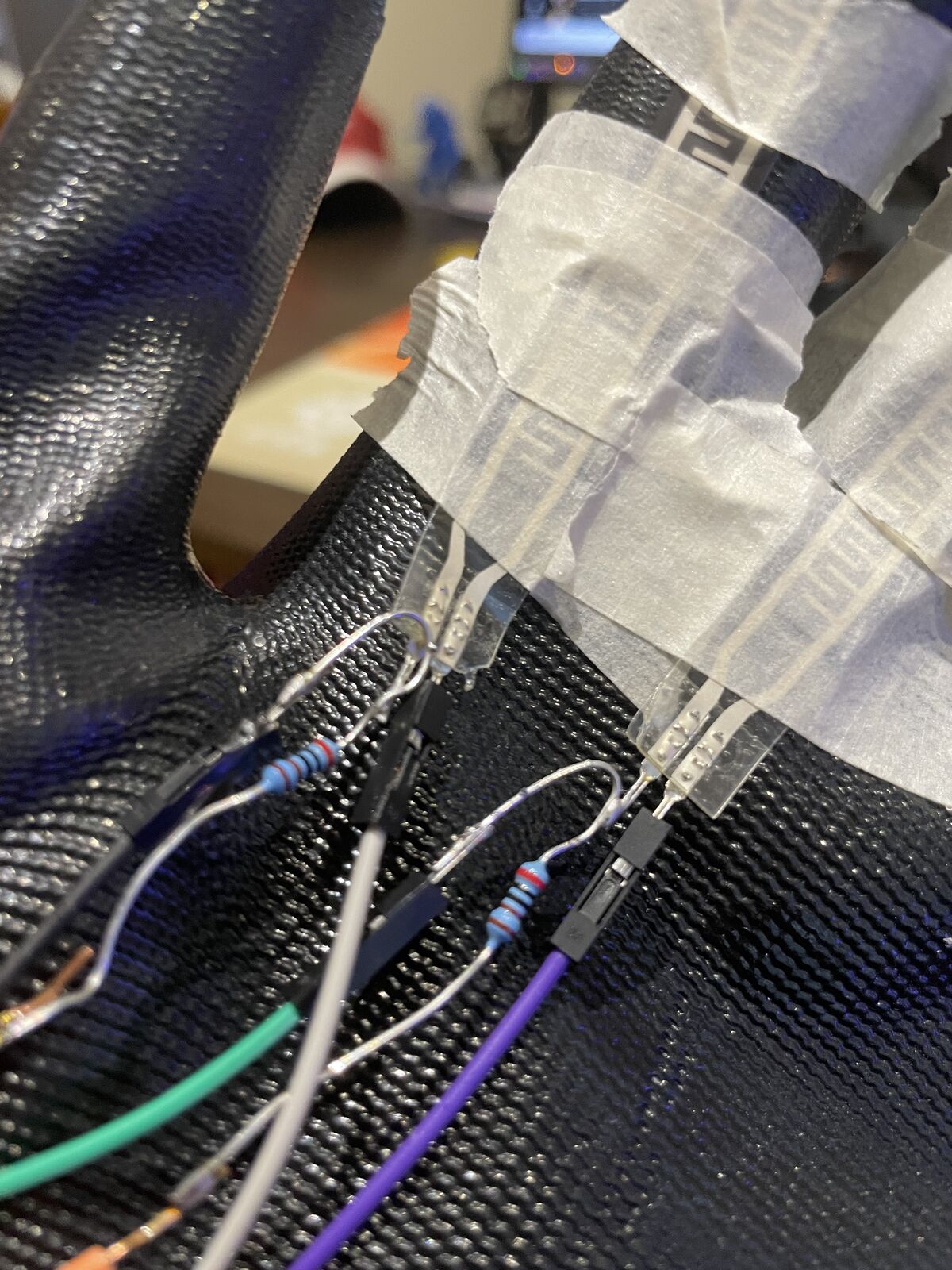
Each flex sensor pairs with an inline resistor to form a voltage divider, soldered point-to-point and strain-relieved with tape so the wiring survives a clenched fist.
Getting it off the bench
Before anything flew, the glove's signals had to look like a normal radio link to the flight controller. That meant calibrating each flex sensor's range in the firmware, then watching the receiver tab in Betaflight Configurator move as fingers curled, until every channel tracked the way a real transmitter's would.
The receiver tab in Betaflight Configurator, with each bar moving as a finger curls, the same channel mapping any new transmitter goes through.
Launching from an open palm: props spin up and the drone climbs off the hand under its own power.
It lifts off, and the glove's channels move in Betaflight the way a transmitter's would. Flying it on gestures alone, reliably, is still ahead of us. What we built ourselves is the frame, the glove, the wiring, and the firmware that turns a bending finger into a channel value; the motors, the flight controller, and Betaflight itself are off-the-shelf parts we integrated. It's still the most end-to-end project either of us has taken on: mechanical design, electronics, firmware, and flight tuning all have to work at once, or nothing leaves the ground.